





Date:
January 6, 2026
Author:
Ian R. Cohen
/
Founder & Principal Attorney
The "honeymoon phase" of corporate AI adoption has officially ended. For many organizations, 2025 was about legal debt: deploying AI without a framework. 2026 is when that debt comes due. We have entered the Accountability Era, where the competitive advantage is no longer just how much AI you use, but how well you govern it.
For the modern enterprise, AI is no longer a shiny new tool; it is foundational infrastructure. However, infrastructure that lacks oversight is a liability. To build a resilient organization, leaders must move beyond generic concerns about "robots taking jobs" and address the sophisticated, systemic risks of integrated AI.
The Three Pillars of Modern AI Risk
In 2026, the risks associated with Artificial Intelligence have evolved. We are no longer just worried about a chatbot being rude. We are worried about autonomous agents making unauthorized commitments.
1. Agentic Autonomy and "Shadow AI"
We have moved from passive AI (chatbots) to Agentic AI—systems capable of executing workflows, accessing bank accounts, and negotiating with vendors. The risk here is "Unauthorized Agency," where an AI agent exceeds its intended permissions or makes a legal commitment the business cannot fulfill.
Such problems and mistakes will not be excused by finger pointing at AI.
2. The 2026 Regulatory Cliff
With the EU AI Act now in effect and a patchwork of new state-level regulations in the U.S., compliance is no longer optional. "Black box" models—where a company cannot explain why an AI made a specific decision—are becoming a massive legal and financial liability.
Regulators are extremely focused on “high-risk ai systems” that may significantly impact a person’s life. This includes employment and HR, essential private services, such as financial, banking and health, critical infrastructure, education, among others.
3. Model Drift and "AI Slop"
AI models are not static. Over time, their performance can degrade—a phenomenon known as Model Drift. Without rigorous monitoring, a system that provided expert-level insights six months ago may now be producing "AI Slop": low-quality, factually thin, or biased outputs that erode customer trust.
AI is moving too quickly to let it run free without continuous oversight and updating.
Strategic Mitigation: A Playbook for Leadership
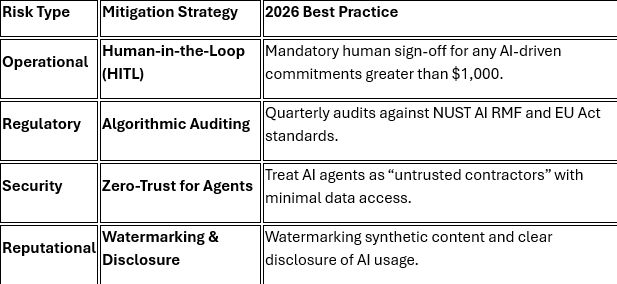
Building products and processes through AI doesn't mean being fearless; it means being prepared. Here is how high-performing organizations are mitigating these risks today.
The Governance Framework
Implement an "AI Council"
Authority begins with ownership. Do not leave AI oversight solely to the IT department. A modern Cross-Functional AI Council should include:
• Legal/Compliance: To monitor the shifting global regulatory landscape.
• Operations: To ensure AI workflows are actually driving ROI.
• Ethics/HR: To monitor the impact of AI on workforce morale and consumer bias.
Invest in "Explainable AI" (XAI)
If your business uses AI for high-stakes decision-making (hiring, credit scoring, or pricing), you must prioritize Explainability. If a regulator or a customer asks why a decision was made, "the algorithm said so" is a losing answer. Use XAI tools to ensure every automated output has a traceable logic trail.
XAI is a liability shield if maintained and used properly.
Conclusion: Governance as a Growth Lever
Many leaders view risk mitigation as a "brake" or something that slows the company down. In reality, the opposite is true. It’s the reason you can safely drive at 100 mph.
In an era of deepfakes and automated misinformation, trust is the ultimate premium. By implementing robust AI governance, you aren't just avoiding fines; you are proving to your clients, investors, and employees that your organization is a safe, reliable partner.
The companies that will dominate the late 2020s are not those that adopted AI the fastest, but those that scaled it with the most integrity.
Is your AI infrastructure a growth engine or a ticking liability? IRC Legal helps mid-market firms build robust Governance Frameworks without the overhead of a full-time legal department. Schedule an AI Risk Assessment today to ensure your 2026 strategy is built on a foundation of trust and integrity.