






Date:
September 1, 2026
Author:
Ian R. Cohen
/
Founder & Principal Attorney
The fractional GC engagements that fail all fail the same way: vague scope, no rhythm, and a CEO who finds out about problems after the contract is signed. The ones that work feel like having a GC on the team — because that is the job.
So before I take an engagement, I structure it. Here's exactly how.
It Starts With an Audit, Not a Retainer
Before I can tell you what you need, I need to see what you have. And what you don't.
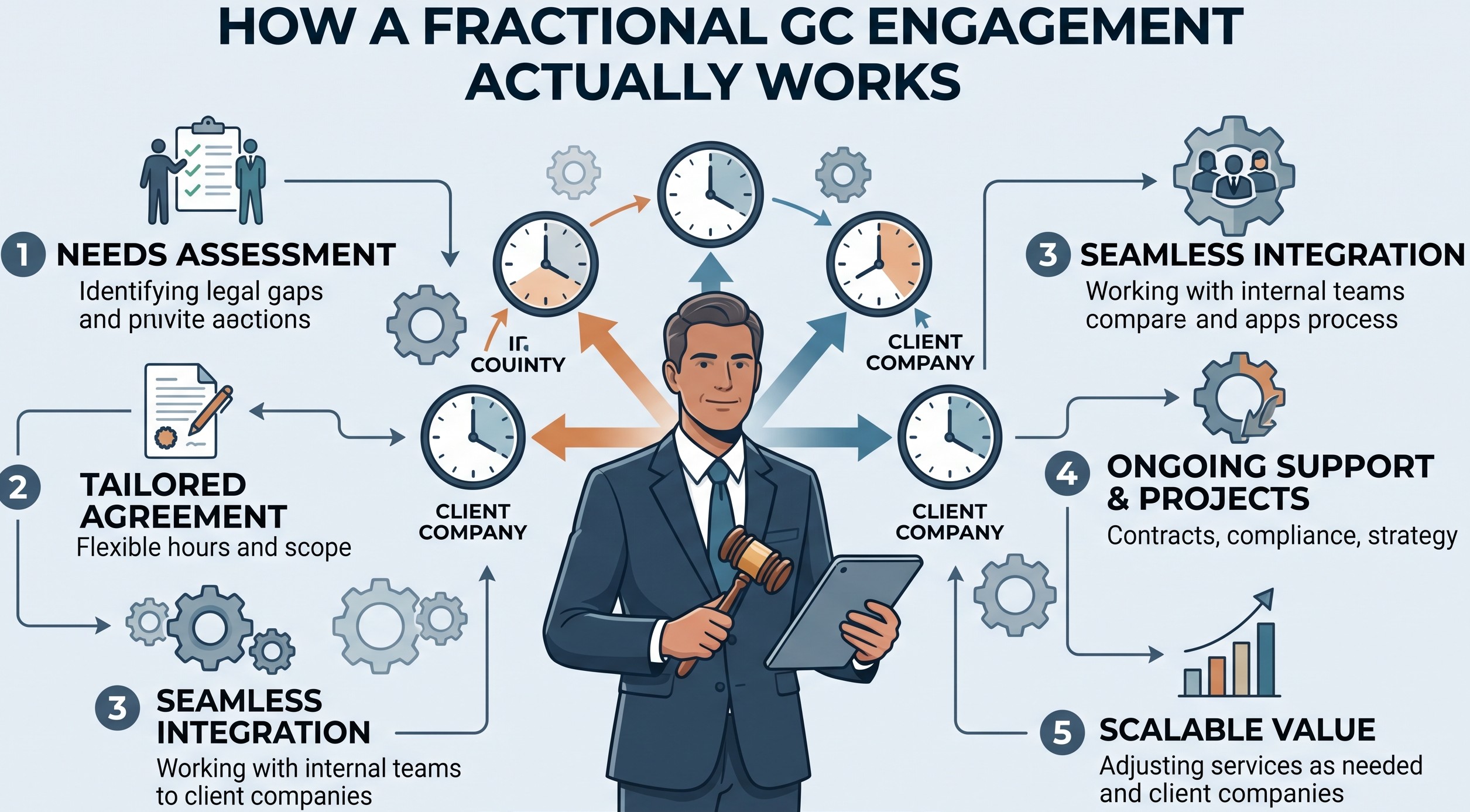
The first two weeks are a legal audit: corporate documents, key contracts, employment practices, compliance posture, cap table, board materials, anything pending or threatened. I talk to the CEO, the CFO, and whoever else touches legal decisions.
The output is a written assessment that says three things: where the gaps are, what gets fixed now, and what we build over the first 90 days. It's a diagnostic, not a sales exercise. I've done assessments where the conclusion was "you don't need me yet" — and said so. More often, the assessment surfaces problems the company didn't know it had.
The audit is included in the first month's retainer — the hours count against your tier. No separate fee. And month one often runs past the 10-hour floor: the audit is the work. I flag the overage before it lands.
Three Tiers
The right tier depends on how much legal activity the company generates and how involved you want me. Every engagement starts at 10 hours a month.
Foundation — 10 to 15 hours a month. For companies with steady but moderate legal volume. Same structure as every tier — the standing call, the monthly summary, me on Slack — pointed at contract review, employment questions, and governance. A smaller block of hours, not a smaller role.
Growth — 20 to 30 hours a month. The most common tier. Active contract pipelines, board governance, some regulatory complexity. At this level I'm on the leadership calls, managing outside counsel relationships, quarterbacking compliance projects, and handling the harder negotiations.
Scale — 30 to 40 hours a month. For companies where legal is near-daily: heavy contract volume, multiple workstreams at once, real regulatory load. At Scale I'm in the company's operating cadence, not just the legal one — the leadership meeting, the pipeline review, wherever decisions get made. Functionally inside the leadership team.
Deal work is different. A capital raise or an M&A transaction isn't a retainer tier — it runs hourly or on a scoped fee, the same way I price it for M&A clients. The retainer keeps the company running while the deal runs.
Every tier has a pre-agreed overage rate, I track hours transparently, and I flag it when we're approaching the cap. There are no surprise bills.
The Rhythm
Random emails and Slack messages without context don't produce good legal work. Structure does.
A standing call, weekly or biweekly by tier, 30 to 60 minutes. Active matters, pending contracts, upcoming decisions. I bring the agenda; you add to it. Most "urgent" legal questions stop being urgent when there's a standing call to catch them.
Between calls, I'm on email, Slack, or Teams, and I respond the same business day. Truly urgent, call me.
End of every month, a short written summary: what was handled, what's pending, what decisions are needed, what's coming. The board sees the legal function without a separate report-out.
Board meetings — I prep the materials, sit in the meeting, and handle the resolutions and follow-up. Available at any tier; the time comes out of your block.
What's In Scope and What Isn't
In scope at every tier: commercial contracts, employment law guidance, corporate governance, risk and compliance planning, pre-suit disputes and demand letters, managing outside counsel on specialized matters, and strategic counsel on decisions with legal consequences. At Growth and Scale: capital raise preparation, M&A readiness, regulatory compliance programs, IP strategy, insurance review.
Out of scope, always: courtroom litigation, patent and trademark prosecution, tax opinions, immigration, complex benefits work. When a matter heads to court, it goes to litigation counsel I manage — I don't hand it off and walk away. I run the referral, review the work product, and watch the meter. Someone watching the outside counsel meter is one of the most valuable things a fractional GC does.
The First 90 Days
Here's the realistic timeline for a company that hasn't had a GC before. If I'm taking over an existing function, everything moves faster.
Month one: triage. The audit. The three to five items that need immediate attention get fixed first. The communication cadence starts.
Month two: foundation. The typical build: contract templates standardized, employee handbook current, governance records clean, a contract tracking system that will survive diligence someday. If some of that infrastructure already exists, month two goes deeper instead.
Month three: steady state. The calls have a rhythm. Contract review flows. You know when to call me and what to handle without me.
One audit from a recent engagement: a growth-stage company, two years past its seed round, planning its next raise. The data room looked fine until I lined the cap table up against the paper behind it — option grants the board had approved and nobody had ever issued, and a former contractor with code in the product and no IP assignment. Six weeks of cleanup at Foundation-tier hours. When the raise came, diligence found nothing, because there was nothing left to find.
What I Need From You
This is a two-way relationship, and the failures on the company side are as predictable as the failures on the lawyer side.
One point of contact who can make decisions. Contracts before they're signed, not after. Hires and fires before they happen, not in the recap. And follow-through — I can draft the policy, but if nobody implements it, the risk is still yours.
Tell me today, not at 6 p.m. tonight. Structured communication prevents almost every fire drill.
The Terms
The initial commitment is 90 days — long enough for the audit and the build to mean something. After that, either side can walk on one month's written notice. Conflicts are checked before anything starts. Billing is transparent: real time entries, no block billing, ask me about any line item and I'll explain it.
And when you've grown into a full-time GC, I help you hire one and hand over a clean function. The model is supposed to end that way.
If legal is landing on your desk, outside-firm spend is climbing, or a raise or sale is coming, that's the moment this model fits. Book a strategy session and we'll figure out the right tier in one call. The full service picture is on the fractional General Counsel page.
New to the model? Start with what a fractional GC is and when you need one, or why hiring a law firm is sometimes the wrong answer.
About the Author: Ian R. Cohen is the founder of IRC Legal, a boutique law firm on Long Island offering strategic M&A counsel and fractional General Counsel services. 17+ years of experience. 500+ closed transactions. $3B+ in aggregate deal value. He came up through Schulte Roth & Zabel and BakerHostetler, served as in-house General Counsel of a PE-backed company through nine-figure financings and a public-market process, and built IRC Legal around direct, senior-level counsel.