







Date:
June 25, 2026
Author:
Ian R. Cohen
/
Founder & Principal Attorney
There's a moment in every company's growth where the founder realizes they're spending more time on legal problems than on the business. The contracts are piling up. The board wants governance. The investor has questions about the cap table. And the outside law firm is billing $1,500 an hour to learn the business from scratch every time a new issue surfaces.
That's when the fractional GC conversation starts.
What a Fractional GC Actually Is
A fractional General Counsel is a senior attorney who serves as your company's chief legal officer on a part-time or project basis. Not an outside firm you call when something breaks. Not a junior lawyer embedded at a discount. A seasoned GC who sits inside your business, knows your cap table, your board dynamics, your vendor relationships, and your risk tolerance. But doesn't need a W-2 or benefits package to do it.
I've served as fractional GC for companies ranging from pre-revenue startups to PE-backed platforms doing $50 million in annual revenue. The work is the same work a full-time GC does. The difference is I'm doing it across a handful of companies instead of one, and each of those companies gets senior-level judgment without the $400,000-plus fully loaded cost of a full-time hire.
What the Job Looks Like
The fractional GC role covers the same ground as any in-house legal leader. I review and negotiate commercial contracts. Vendor agreements, customer MSAs, partnership deals, licensing arrangements. I manage outside counsel when litigation or specialized regulatory work requires it. I advise the CEO and board on governance, compliance, employment matters, and M&A strategy.
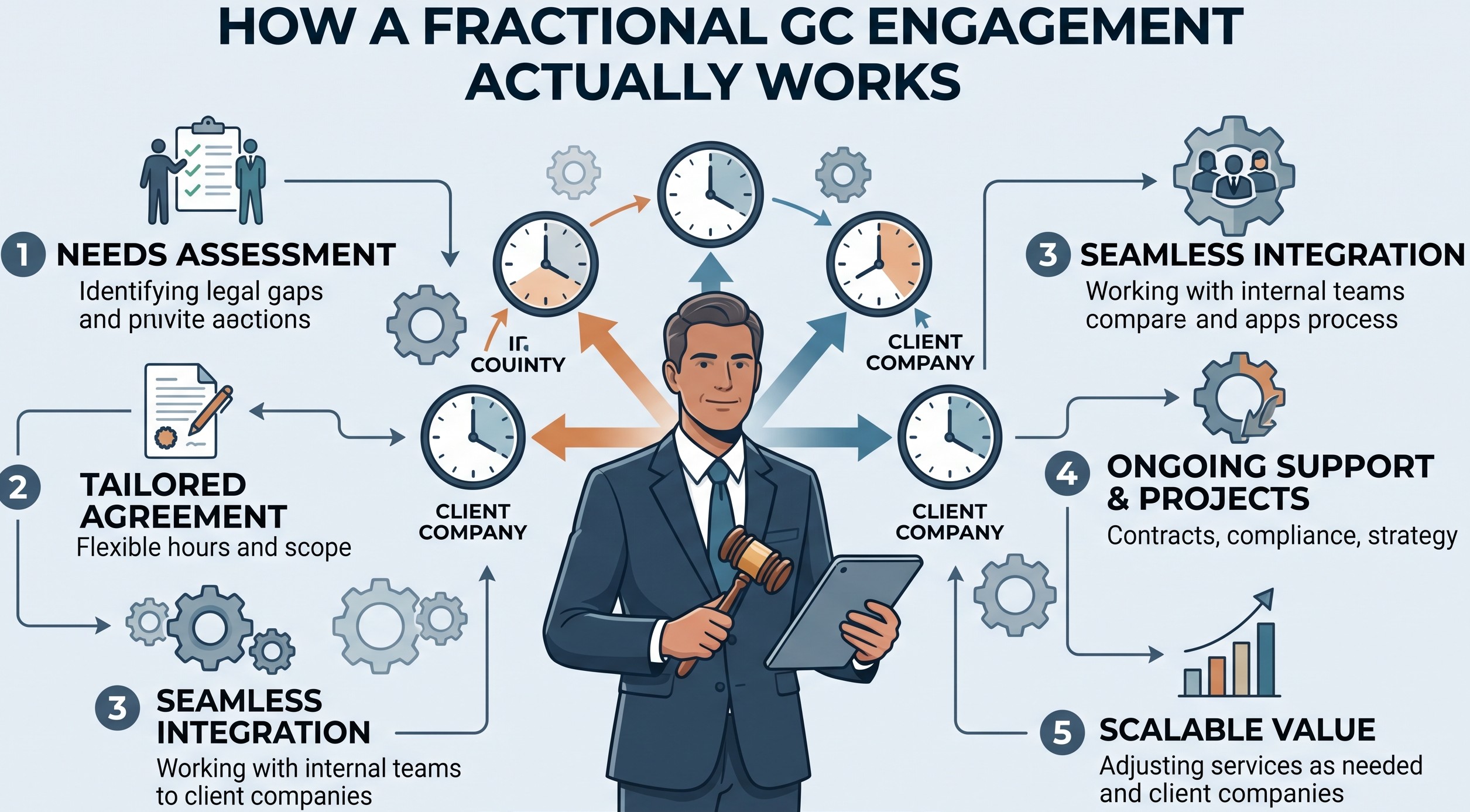
The difference is how the engagement is structured. The retainer runs in tiers from 10 to 40 hours a month, and it flexes because the business flexes — heavier when the company is busy, lighter in maintenance stretches. A fundraise or an acquisition is its own workstream, priced hourly or on a scoped fee alongside the retainer. I wrote up the full mechanics — the audit, the tiers, the cadence, the first 90 days — in How a Fractional GC Engagement Actually Works.
What doesn't flex is the depth. A fractional GC isn't a lawyer you check in with occasionally. I'm in the Slack channels. I'm on the management calls. I know why the VP of Sales is pushing back on a contract term because I was in the room when the policy was set. That institutional knowledge is what separates a fractional GC from an outside firm that parachutes in, runs the meter, and parachutes out.
When It Makes Sense
The sweet spot is a company between $5 million and $75 million in revenue that has real legal needs but can't justify a full-time hire. Or doesn't want one. That covers a lot of ground: Series A and B startups scaling their commercial operations, PE portfolio companies that need legal leadership during a hold period, founder-led businesses approaching a sale.
It also makes sense when the legal work is strategic, not just reactive. If the company is negotiating a major partnership, preparing for an acquisition, cleaning up governance ahead of a fundraise, or integrating a bolt-on, those are moments where having a GC-level attorney inside the business changes outcomes. An outside firm will draft the documents. A fractional GC will tell you whether the deal should happen in the first place.
What It's Not
A fractional GC is not a document review service. If you need someone to redline NDAs all day, hire a contract manager. It's not a substitute for litigation counsel. When you're getting sued, you need a litigator, and a good fractional GC will find you the right one and manage the relationship.
It's also not a part-time version of a junior lawyer. The entire value proposition depends on seniority. You're hiring judgment, not hours. The fractional GC who spent a decade in BigLaw M&A and another five years running legal for a growth-stage company is going to spot the landmine in a vendor agreement that a third-year associate would miss entirely. That's the point.
The Economics
A full-time General Counsel at a mid-market company runs $300,000 to $500,000 in total compensation. A fractional GC engagement typically runs $8,000 to $20,000 per month depending on scope. The math isn't complicated.
But the real savings aren't in the GC's comp. They're in what the fractional GC prevents. The acquisition that gets restructured because someone caught the liability buried in the target's customer contracts. The vendor deal that gets renegotiated before auto-renewal locks in unfavorable terms for another two years. The employment issue that gets handled before it becomes a lawsuit.
Legal problems don't age well. I wrote about this recently. The conversation that costs five thousand dollars today costs fifty thousand in six months and five hundred thousand in litigation. A fractional GC keeps the five-thousand-dollar conversations happening on a regular basis so the five-hundred-thousand-dollar ones never start.
How to Know You're Ready
If any of these sound familiar, you're probably ready:
Your CEO is reviewing contracts. Your outside counsel doesn't understand the business. Your board is asking about governance and nobody has an answer. You're about to raise capital or sell the company and the legal house isn't in order. You have a dozen vendor agreements and nobody knows what's in them.
The fractional GC model exists because companies at this stage need strategic legal leadership, not more billable hours from a firm that treats them like a small client. The work is too important to outsource entirely and too expensive to staff full-time.
There's a middle path. It works.